Please put an active hyperlink to our site (www.rusnature.info) when you copy the materials from this page
Physical Geography of Northern Eurasia
Biodiversity and Productivity of Ecosystems
<<< Spatial Patterns of Microbial
Communities | Physical Geography Index | The Present and Future of Biodiversity of Northern Eurasia
>>>
Geography of Animal Communities
The trophic structure of animal communities and zoomass correlate closely with
distributions of other components of organic matter and NPP in both zonal (Chernov et al.,
1967) and mountainous (Zlotin, 1975,1978) ecosystems. There is also a strong correlation
between members of trophic chains and the availability of organic matter for consumption
(i.e., between phytophages and NPP, herbivores and green phytomass, saprophages and plant
fall, predators and their prey). The ratio of both maximum biomass of phytophages and NPP,
and maximum biomass of predators and their prey is about 1/100 and varies little between
biomes. Variability in the primary to secondary production ratio is small because in the
process of transfer of energy from one trophic level to another 90 per cent of energy
stored on the lower level is lost. The total production of animal populations comprises
about 0.5-2.0 per cent of annual primary production in most biomes (i.e., tundra, forests,
grasslands, and deserts) (Zlotin, 1975).
Every biome in Northern Eurasia has a specific animal community whose structure changes
with respect to MAI (Table 7.4).
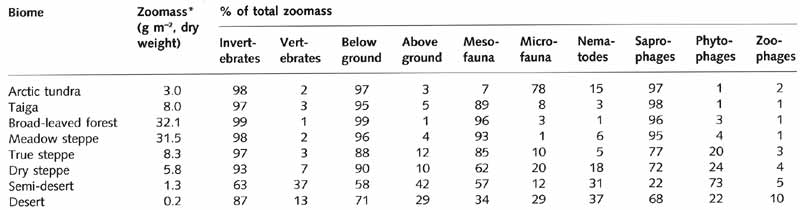
Table 7.4 Structure of animal communities.
* All taxonomic groups of animals except protozoans. Source: Zlotin and Bazilevich (1993).
The share of vertebrates and animals living above the ground increases southwards from
humid to arid ecosystems, as well as the importance of two trophic groups of consumers
(herbivores and carnivores). The share of saprotrophic invertebrates is greater in humid
ecosystems.
<<< Spatial Patterns of Microbial
Communities | Physical Geography Index | The Present and Future of Biodiversity of Northern Eurasia
>>>
|