Please put an active hyperlink to our site (www.rusnature.info) when you copy the materials from this page
Biomes and Regions of Northern Eurasia
Boreal Forests
<<< Central Siberia | Biomes & Regions Index | Mires
>>>
Eastern Siberia and the Far East
Zonal forest associations are practically absent from Eastern Siberia and the Far East.
Both are predominantly mountainous regions and in the Pacific the influence of the ocean
modifies zonal successions. Montane forests and the Far Eastern taiga are discussed below
and this section discusses the taiga of the East Siberian plateaux and valleys, the Sea of
Okhotsk coast, and the Amur basin (Figure 9.7).
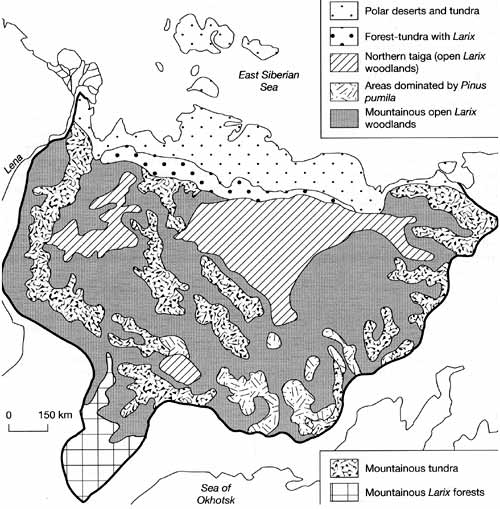
Fig. 9.7 Vegetation of Eastern Siberia. Compiled by A. Tishkov using
data from Sochava (1979)
The formation of forests in Eastern Siberia is limited by the extreme climate. The
lowest temperatures in the Northern Hemisphere occur here with the absolute minimum of -71
°C registered in Oimyakon. Similar to Central Siberia, precipitation is very low and less
than 20 per cent of it occurs in winter. The depth of snow cover is consequently small,
between 20 cm and 30 cm. In this rigorous climate, open forests composed of Larix gmelinii
with thickets of Pinus pumila and Betula middendorfii develop (Figure 9.7). In places,
forest cover breaks down giving way to thickets of Pinus pumila, Betula middendorfii, and
in the eastern regions, Betula lanata.
In the maritime climate of the Sea of Okhotsk coast, winter temperatures are much
higher than in Eastern Siberia (the mean January temperatures vary between -20°C and
-23°C) with frequent thaws, abundant snowfalls, and strong winds. Summers are cool, with
mean July temperatures of 12-16°C. The lack of heat in summer predisposes the development
of larch forests formed by Larix ochotensis (endemic to the Sea of Okhotsk coast), L.
cajanderi (which occurs at some distance from the coast), Picea ajanensis, Pinus pumila,
and Betula lanata. The latter is a montane tree, which can endure severe climate and grow
on thin soils. In coastal forests, tree growth is hampered by strong winds and ice
abrasion and trees often develop stunted shapes. In the montane valleys, stands are well
developed and form closed forests.
The taiga, which occurs in the Amur basin, has a complex composition of vegetation
which distinguishes it from the rest of the boreal zone. Ecosystems of the Far East
comprise a wide spectrum of species representative of the Okhotian, East Siberian,
Dahurian, and Manchurian floras. The mixture of plants, which differ in origin and
ecology, make it a truly transitional region. Southern Manchurian species (e.g., Quercus
mongolica, Juglans mandshurica, and Vitis amurensis) frequently occur alongside the
typical taiga species and in the Amur valley they are found at 54°N. The Dahurian
element, typical of the southern Transbaikal region, brings herbaceous species, such as
Tanacetum sibiricum and Leontopodium sibiricum. These plants occur mainly on the northern
slopes of the Amur basin in the western parts of the region but are also found on the
Pacific coast. The East Siberian flora penetrates from the north-west. Larix gmelinii and
Picea obovata dominate in the habitats on permafrost, particularly in the basin of the
river Zeya. Picea ajanensis and Abies nephrolepis with an admixture of Betula lanata, the
typical representatives of the Okhotian flora, occur in colder habitats such as northern
slopes or valleys with a microclimate controlled by the cold air drainage. Because
mountains reach a considerable height, altitudinal zonation occurs in the distribution of
forests. Forests, composed by the taiga species, develop at higher altitudes while in the
lower mountains mixed forests with the participation of Tilia mandshurika, T. komarovii,
and Quercus mongolica occur. Both types of forests have a well-developed and floristically
rich undergrowth. Ginseng, a species with well-known medical properties, still occurs in
the montane forests in the wild.
<<< Central Siberia | Biomes & Regions Index | Mires
>>>
Contents of the Boreal Forests section:
Other sections of Biomes & Regions:
|
|