Please put an active hyperlink to our site (www.rusnature.info) when you copy the materials from this page
Russian Zapovedniks and National Parks
<<< Zapovednik "Darvinsky" | Index and Map | Zapovednik "Kivach"
>>>
Zapovednik "Kandalakshsky"
Address: 184040 Murmanskaya obl., Kandalaksha, Lineynaya st., 35
Zapovednik Kandalakshsky is situated on the South and North of Murmanskaya Region,
partly in the Republic of Karelia. It was established in 1932. The Zapovednik has been
existing within its present boundaries since 1977. Its area is 70,5 thousand ha, including
49,6 thousand ha of water area.
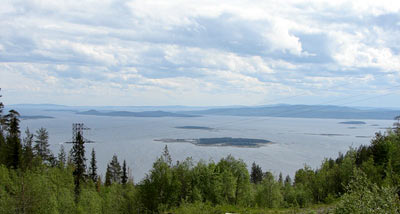
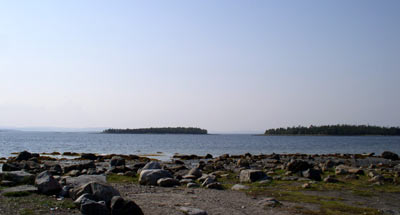
The Zapovednik is situated on islands and Barents Sea shore and Kandalaksha Bay of the
white Sea. The islands Ainovy, Gavrilovskiye and the Seven Islands Archipelago (Barents
Sea) carry communities of the tundra zone, mainland and the islands of the Kandalaksha Bay
— northern taiga.

The cluster pattern of the Zapovednik determines its complex structure and
great nature diversity. On the islands of the Barents Sea and narrow (500 m) shore zone
(off the Seven Islands Archipelago) the maritime varieties of tundra vegetation are found.
On the shore, stony-lichen and shrub-lichen tundras predominate without forming continuous
cover. In depressions, shrub tundras are located, with crowberry, blueberry, black-berry,
cowberry and dwarf birch. On the islands large areas are occupied by crowberry tundras
with cloudberry. Where large bird colonies are, a thick peat layer is accumulated, formed
by bird excretion products to give rise to a peculiar ornithogenic vegetation with Arctic
camomile, scurvy grass, sorrel, fescue.
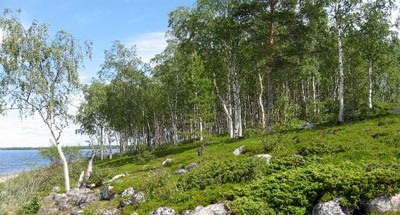
A peculiar feature on the Ainovye islands is tall-grass meadows and fern thickets.
Tundra communities with crowberry domination are also characteristic of some islands of
the Kandalaksha Bay. In the Kandalaksha site of the Zapovednik various maritime forests of
different stage of development are common — from primary(on the sea islands) to
well-developed (on the shore).
To be found there are pine forests with cowberry and blackberry, occasionally with an
admixture of spruce; pine-spruce forests with an admixture of birch, spruce forests being
less frequent. More than 12% of dry land is occupied by mires, mostly by eutrophic fens.
The littoral zone plant cover are flower plants and algae, in depth, thickets of Laminaria
are abundant.
The flora comprises 633 higher plant species. Among the rare plants listed in the Red
Data Book of the Russian Federation are: Helianthemum arcticum, yellow lady's slipper,
spurred coral root, etc.
The Fauna of terrestrial vertebrates includes 160 species. The forest dwellers are: the
moose, brown bear, red fox, blue hare, squirrel, marten, ermine. The wolf, wolverine and
lynx appear regularly. The birds are the capercaillie, black grouse, hazel grouse, willow
grouse, kestrel, great gray owl, Ural owl, big owls (great gray owl, Ural owl), etc. On
the island Kharlov (Seven Islands) there is a big population of Norwegian lemming. On the
islands of the Barents Sea, the red fox and polar bear occasionally appear. Ainovye
islands provide nesting grounds to the puffin, glaucous gull and herring gull, eider duck,
Arctic tern. On the Seven Islands the density of bird colonies is high: common (black)
guillemot and thick-billed guillemot, kittiwake, scoot, puffin, Arctic tern. Practically
at all the sites of Zapovednik provide habitat to eider duck, red-breasted merganser,
scoter.
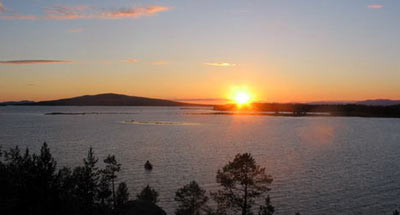
The constant aquatic mammal dwellers of the Kandalaksha Bay are: the bearded seal,
ringed seal. The Kandalaksha Bay is home to more than 30 fish species, including the cod,
White Sea herring, three-spined stickleback, etc.
Sea invertebrates are numerous. Five rare animals listed in the Red Data Book of the
Russian Federation occur in the Zapovednik: gray seal, white-tailed eagle, osprey, shag,
Arctic falcon.
The Zapovednik has some archaeological sites — remains of one Russia's first silver
mines.
The Zapovednik is part of wetland of international significance.
<<< Zapovednik "Darvinsky" | Index and Map | Zapovednik "Kivach"
>>>
|