Please put an active hyperlink to our site (www.rusnature.info) when you copy the materials from this page
Russian Zapovedniks and National Parks
<<< Zapovednik "Olekminsky" | Index and Map | Zapovednik
"Poronaisky" >>>
Zapovednik "Ostrov Vrangelya"
Address: 686830 Chukotsky АО, Chachunsky r-n, Pevek, Obrucheva
st., 4/1, corp.2, off.14.
Zapovednik Ostrov Vrangelya, in the Arctic Ocean, was established in 1976. Its area is
2225,6 thousand ha, 795,6 being the terrestrial part.
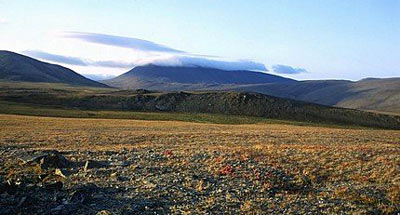
The Zapovednik is located on the Vrangel and Gerald islands on the boundary between the
Eastern-Siberian and Chukotskoye (Chukchi) seas; the aquatic part comprises a 12-mile zone
off the Vrangel and Gerald islands, except one site off the Vrangel shore from the mouth
of river Khischniki to cape Havaya.
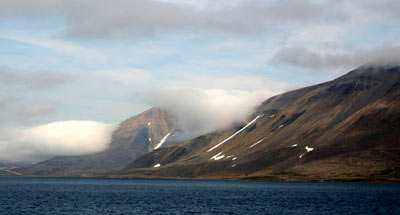
The topography is mountainous, highly dissected. The Vrangel Island has about 900
lakes. The vegetation is that of Arctic tundras. Lower and middle parts of mountain slopes
are occupied by grass-lichen, Dryas-grass-lichen, and, occasionally, shrub-forb tundras.
In south-western and central parts of the Vrangel Island, relict steppe and tundra-steppe
communities with a great diversity of flowers are widespread. There are sedge bogs with
sphagnum moss, sedge-cottongrass bogs, thickets of elfin willows. On mountain tops are
large numbers of rocks with rare spots of moss and lichen.
The flora includes more than 300 vascular plant species, many of them are endemic and
rare (Oxytropic wrangeli, Poa vrangelica, Papaver gorodkovii, Papaver lapponicum —
listed in the Red Data Book of the Russian Federation).
The fauna is not rich, no amphibian or reptile species are recorded. The common mammals
are the Siberian lemming and collared lemming, polar fox (separate population). The red
fox, wolf, wolverine, ermine appear repeatedly. In the offshore waters dwell the ringed
seal, bearded seal, and there are walrus rookeries, which are the largest in Russia. In
the sea whales occasionally appear, including the bowhead whale, killer whale, white
whale.
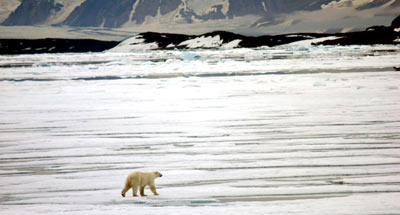
On the Vrangel Island polar bears assemble during the breeding season (the polar bear
is listed in the Red Data Books of IUCH and the Russian Federation), where they make their
dens.
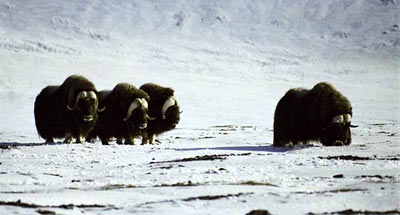
The musk-ox (Ovibos moschatus), domestic reindeer (Rangifer tarandus) were imported.
40 avian species are recorded. Bird colonies are characteristic (the background species
are the kittiwake, pelagic cormorant, guillemot). The snow goose forms a nesting colony,
which is the largest in Eurasia. Lapland longspur and snow bunting are numerous; the brent
goose, eider duck, glaucous gull, robin sandpiper, and snowy owl have their nesting here.
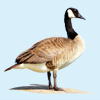
Little brown crane, Canada goose occasionally appear.
There are remains of paleo-Eskimo camps and dugouts of ancient Eskimos hunters are
found.
<<< Zapovednik "Olekminsky" | Index and Map | Zapovednik
"Poronaisky" >>>
|