Please put an active hyperlink to our site (www.rusnature.info) when you copy the materials from this page
Biomes and Regions of Northern Eurasia
The Arctic Environments
<<< The Present and Future of
Biodiversity of Northern Eurasia | Biomes & Regions Index
| The Arctic Oceanic Shelf >>>
Introduction
Defining the Arctic is a contentious issue in geography. Some define the Arctic as the
Arctic oceanic shelf, islands, and a narrow strip of coast; others use this term to
describe polar deserts, tundra, and forest-tundra biomes. It is often defined as the
territory within the Arctic Circle where polar day and polar night occur. Further
confusion is caused by a synonymous term, the Far North, which in the Russian-language
literature is used to describe both the Arctic region and, in relation to development
issues, engineering, and construction, the area of permafrost occurrence. However, the
permafrost boundary reaches 49°N and, if this criterion is used, almost the whole of
Siberia should be included in the Arctic region. In this chapter we will delimit the
terrestrial Arctic using biological and climatic criteria and include treeless
environments located north of the climatic boundary at which the annual radiation budget
is 15 kcal cm2 and the mean July air temperature does not exceed 10°C (Young,
1989). One of the accepted definitions of the maritime Arctic is according to the presence
of pack ice during most of the year (Young, 1989). In this chapter, we will consider five
marginal seas: the Barents, Kara, Laptev, East Siberian, and Chukchi.
Two factors make the Arctic unique: its high latitude position and the presence of the
Arctic Ocean. The severity of climate, contemporary glaciation, sea ice, permafrost, and
snow cover, persisting for most of the year, are characteristic features of the Arctic.
Arctic landscapes comprise polar desert and tundra. They extend along the Arctic coast
from the Kola peninsula in the west to the Chukchi peninsula in the east. The topography
of western and central Arctic is mainly low, with the exception of the Kola peninsula,
Polar Urals, and two mountainous massifs of Taymyr, while the north-east of Siberia has
mountainous relief. Biodiversity is low in comparison with other regions. Low evaporation
rates and poor drainage, impeded by permafrost, are responsible for an excess of moisture
which leads to waterlogging. Much of the tundra area is covered by lakes and standing
water which freeze in winter.
This chapter commences with a discussion of the maritime Arctic: morphology of the
Arctic continental shelf, production of sea ice and its distribution, and effects of
climatic variability on sea ice regime. A discussion of the contemporary terrestrial
glaciation will follow. The next section will examine vegetation and fauna, including
regional divisions within the Arctic and a survey of polar desert and tundra vegetation.
Limited to a brief review of diverse aspects of the Arctic environments, we will not
specifically focus on such issues as permafrost and associated geomorphological processes,
or general aspects of climate and environmental impacts which are discussed in detail
below. A sketch map of the region and geographical names, which may be unfamiliar to the
reader, are given in Figure 8.1.
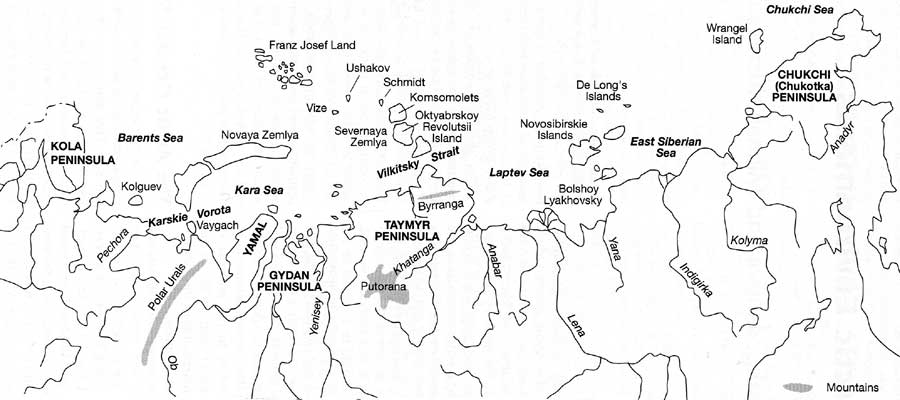
Fig. 8.1 The Arctic region with names used in the text
<<< The Present and Future of
Biodiversity of Northern Eurasia | Biomes & Regions Index
| The Arctic Oceanic Shelf >>>
Contents of the The Arctic Environments
section:
Other sections of Biomes & Regions:
|
|