Please put an active hyperlink to our site (www.rusnature.info) when you copy the materials from this page
Biomes and Regions of Northern Eurasia
Arid Environments
<<< The Future of the Steppe | Biomes & Regions Index | Climatic
Conditions >>>
Introduction
Arid environments are widespread in the south of the Russian Federation (the Caspian
lowland), in Kazakhstan, Turkmenistan, and Uzbekistan. To a lesser extent semi-deserts
also occur in Tajikistan and Kyrgyzstan, as well as in Georgia, Armenia, Azerbaijan, and
in the Crimea.
A vast desert core region of about 3.5 million km2 comprises the entire
Turanian lowland and the southern margin of the Kazakh Knolls (Figure 12.1).
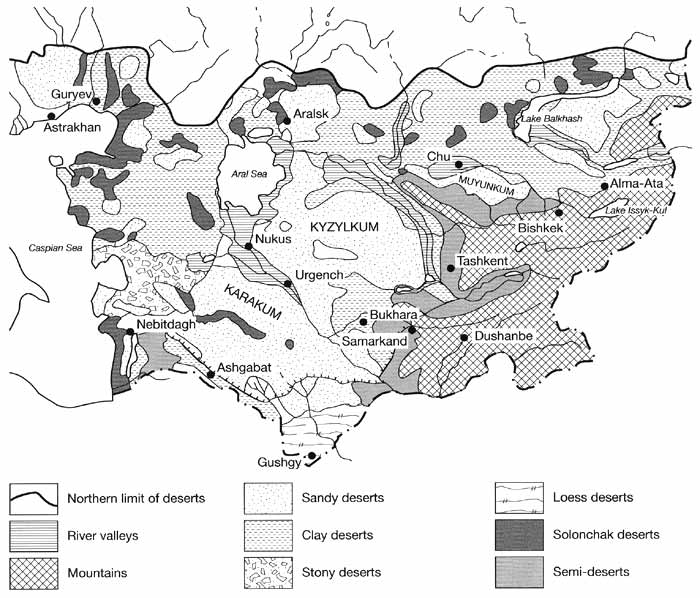
Fig. 12.1 The desert core regions: litho-edaphic conditions of Central
Asia and Kazakhstan. Modified from Babaev (1996)
To the south and south-east it is surrounded by high mountain chains, such as the
Hindu-Kush, Pamir-Alay (7450 m), and Tien-Shan (7440 m), while the relatively low
Kopetdagh mountains (2000 m) are located to the south-west. To the north the Turanian
plain progressively descends northward and westward and opens out towards the Caspian
lowland. Desert conditions also develop on the Apsheron peninsula in Transcaucasia. The
semi-desert biome represents a transitional zone between the dry steppe of Eastern Europe
and temperate desert. It extends from the Terek river valley in the Caucasian piedmonts in
the west, through the Caspian lowland and the Kazakh Knolls to the mountains of Southern
Siberia in the east. Semi-deserts also occupy a considerable part of the Northern
Caucasus, Transcaucasia, and the narrow isthmus of the Crimea peninsula. The northern
boundary of this zone is rather indistinct and lies at approximately 48°N. To the south,
the semi-desert biomes of the Caspian lowland and Kazakhstan progressively give way to
deserts.
Geographical research in this region dates back centuries or even thousands of years.
The first description of the lands eastward from the Caspian can be found in classical
sources (Arrien, Strabo, Ptolemaeus, Herodotus) and in early Chinese chronicals. In the
Middle Ages this area was described both by Arab geographers (Yakut, Istkhari, and Masudi)
and local authors (Birouni, El-Horesmi, Kashgari, and Babur). Systematic studies of the
Central Asian deserts started with the penetration of Russians to this area in the 19th
century. Maps with detailed descriptions of the environmental conditions of this region
can be found in the works of Semenov-Tien-Shansky, Severtsev, Mushketov, Berg, and
Korzenevsky. Since the 1930s, numerous geographical and geological expeditions by the
Academy of Science of the USSR carried out systematic surveys of the arid lands. For a
comprehensive physical geography of the deserts of Central Asia and Kazakhstan one can
refer to the monographs of Murzaev (1953, 1958), Petrov (1976), Rozanov (1984), Gerasimov
(1956), Kovda (1983), and Geller (1968). Over recent decades multidisciplinary research
has been conducted by scientists at the Institute of Deserts of the Turkmen Academy of
Science (Babaev et. al., 1986; Babaev, 1996; Kharin, 1986; Orlovsky, 1982). In Western
literature, the monograph by Letolle and Mainguet (1993) on the Aral Sea region, and works
of Walter and Box (1976, 1983) and Derbyshire and Goudie (1997) should be especially
noted.
<<< The Future of the Steppe | Biomes & Regions Index | Climatic
Conditions >>>
Contents of the Arid Environments
section:
Other sections of Biomes & Regions:
|
|