Please put an active hyperlink to our site (www.rusnature.info) when you copy the materials from this page
Biomes and Regions of Northern Eurasia
Arid Environments
<<< Introduction | Biomes & Regions Index | Litho-edaphic
Types of Central Asian Deserts >>>
Climatic Conditions
The deserts and semi-deserts of the Commonwealth of Independent States (CIS) have a
typically continental climate. Summers are hot, cloudless, and dry, and winters are moist
and relatively warm in the south and cold with severe frosts in the north. The arid zone
is usually divided into two physiographic subzones: northern (Kazakhstan) and southern
(Iran-Turanian) (Petrov, 1976).
Precipitation in the northern deserts and semi-deserts is associated mainly with the
westerly flow and has a distinct maximum in spring-early summer as the influence of the
Siberian high diminishes and convective activity becomes stronger. In the north of the
semi-desert zone the winters are very cold with a mean minimum of -26°C and absolute
minima around -40°C or colder in the north of the Caspian lowland and in the Kazakh
Knolls. Further south, in the so-called northern deserts, the mean July temperature ranges
from 22°C to 25°C, and the annual precipitation from 155 mm to 270 mm (Figure 12.2).
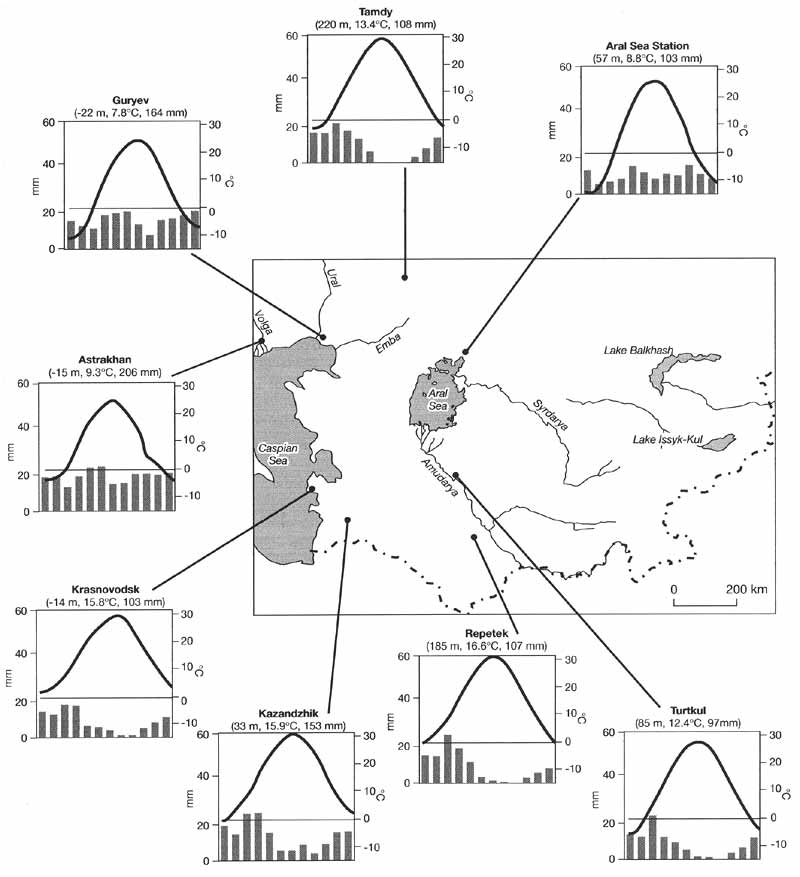
Fig. 12.2 Annual distribution of temperature and precipitation in
several regions of the arid zone
Winter is long and relatively cold with the mean January temperature ranging between
-3°C and -9°C. The mean summer temperature is around 26-28°C. The annual sum of daily
temperatures above 10°C (an index frequently used in agricultural climatology and
biogeography), ranges between 3000°C and 3500°C indicating that thermal conditions are
favourable for plant growth.
In the southern Iran-Turanian deserts precipitation (annual means above 100 mm) has a
spring maximum which is associated with the northward migration of the Iranian branch of
the Polar front. Most frequently, rain is brought by the depressions that develop over the
eastern Mediterranean, migrate north-eastwards and regenerate over the Caspian Sea. The
July temperatures are about 32°C in the southern deserts with a maximum of 52°C in
Repetek (eastern Karakum). The annual sum of daily temperatures above 10°C reaches
4000-5000°C.
<<< Introduction | Biomes & Regions Index | Litho-edaphic
Types of Central Asian Deserts >>>
Contents of the Arid Environments
section:
Other sections of Biomes & Regions:
|
|