Please put an active hyperlink to our site (www.rusnature.info) when you copy the materials from this page
Biomes and Regions of Northern Eurasia
Steppe and Forest-steppe
<<< Mixed and Deciduous Forests: Conclusions
| Biomes & Regions Index | Climate
>>>
Introduction: Main Features and Definitions
Treeless areas, termed steppes, occupy vast areas between boreal forests and temperate
deserts in Eurasia. There are many definitions of steppes. For example, Allan (1946)
provides fifty-four definitions of this term. Stamp and Clark (1979) define steppes as
'mid-latitude areas dominated by herbaceous vegetation and termed locally steppes,
prairies, pampas, high veldts, downland, etc.' A more precise definition of steppes is
offered by geobotanists who define it as a type of vegetation, represented by communities
of drought- and frost-tolerant perennial herbaceous species with a dominance of sedges
(Poaceae) and, less commonly, galingales (Cyperaceae) and bulbs (Alliaceae).
The main features of the temperate steppes are continental climate, the absence of
trees on watersheds, and the predominance of sedges on black and chestnut soils. Steppes
extend as a continuous belt from the plains adjacent to the Black Sea to Western Siberia
and become fragmented east of the Altay because of the mountainous character of the
terrain (Figure 11.1).
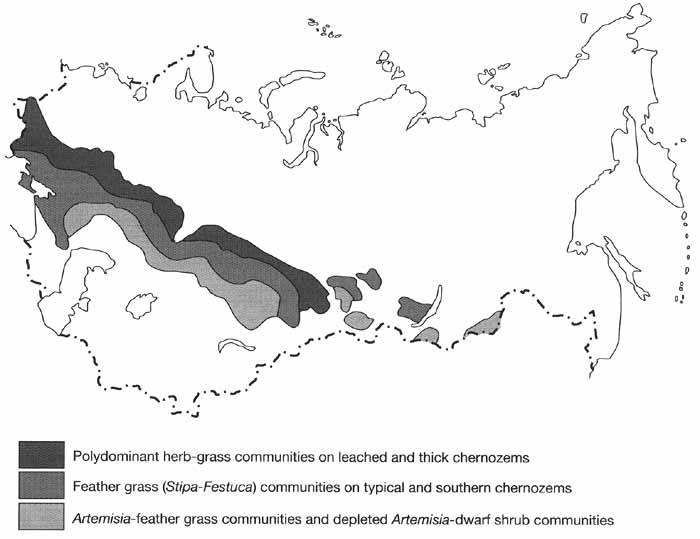
Fig. 11.1 Location of steppe, forest-steppe, and semi-desert zones
Steppe is the main biome located between the humid landscapes of the boreal forests and
the arid environments of deserts. The forest-steppe ecotone occurs between steppes and
forests in the north while semi-deserts form a transition from steppes to the desert
environments. Forest-steppes have a more humid climate than steppes and in their natural
condition represent a mosaic of meadow steppe vegetation and woodlands, ft is the
forest-steppe that serves as a demarcation line between humid and arid environments and
here annual precipitation and evaporation are approximately equal. The forest-steppe
extends as an uninterrupted zone from the Carpathian foothills to the Altay and, similar
to the steppe, becomes fragmented further east. Semi-deserts are distinguished by a more
arid climate than the steppes and the domination of the communities by species of the
genus Artemisia, and sedges. This zone extends from the lower course of the Volga to the
upper course of the frtysh and occupies a considerable part of central Kazakhstan.
Steppes and forest-steppes have been transformed by human activities more than any
other part of Northern Eurasia. In the European part, over 60 per cent of the steppe
territory is now occupied by arable land and in the forest-steppe natural woodlands have
mostly been cleared. It is fair to say that, with the exception of rather small protected
areas, the biogeography of the European steppes and forest-steppes is now cultural rather
than natural. The development of the Asiatic steppes began later and their transformation
has not gone as far as in the western part of the region. However, in many regions
original ecosystems have been transformed by farming and in the late 1950s vast areas in
Southern Siberia and northern Kazakhstan were turned into arable fields in the course of
one of the largest Soviet undertakings ever, the Virgin Land project. Because of it, this
chapter emphasizes the transformation of the environment and adaptation of various
components of the environment to human pressure, rather than approaching the steppes and
forest-steppes of Northern Eurasia from the perspective of traditional biogeography.
<<< Mixed and Deciduous Forests: Conclusions
| Biomes & Regions Index | Climate
>>>
Contents of the Steppe and Forest-steppe
section:
Other sections of Biomes & Regions:
|
|