Please put an active hyperlink to our site (www.rusnature.info) when you copy the materials from this page
Biomes and Regions of Northern Eurasia
Boreal Forests
<<< Fauna | Biomes
& Regions Index | Indigenous Peoples of Taiga
>>>
Forest Fires
Fires in coniferous forests, which are also discussed below, can be a natural
phenomenon (started by lightning) and a human-induced one. Natural fires typically occur
in summer and are preceded by spells of dry and hot weather lasting for several weeks. The
probability of such conditions increases in the Asiatic territory and it is Central and
Eastern Siberia, and the southern Far East that are most prone to burning (Biodiversity
Conservation, 1997). On average, about 20 000 forest fires are registered annually and
2000 and 5000 km2 of forest are destroyed (Table 9.2). In some years, however,
areas of up to 20 000 km2 can be burnt (Gosudarstvennyi Doklad, 1997).

Table 9.2 Area affected by forest fires in Russia in 1996 according to
the registered fire (first number) and burnt-out areas (second number)
Apart from the weather, the action of burning is determined by the character of
terrain, type, and amount of fuel. Flames spread easily across flat terrain while in
dissected relief, the pattern of fire is controlled by complex drainage and microclimatic
conditions. A continuous layer of fuel is necessary for fire to spread. In boreal forests
this layer consists of various types of litter, dry mosses, and lichens. A layer of peat
is often present beneath the surface litter and fires often originate in the peatlands
affected by natural droughts and also in the areas of peat production. Such fires spread
below the surface and are notoriously difficult to deal with because although heavy
rainfall may affect the upper layer of peat, fire spreads further down to a depth of 3-4
m. On average, there are 100-350 events of peat fire each year affecting a few thousand
hectares which accounts for only a small proportion of forest fires. However, in the case
of a peat fire about 120 tonnes of organic matter per hectare are burnt which is 3-10
times more than in the case of an above ground forest fire and carbon emissions are much
higher in the case of a peat fire (Isaev et. al., 1995).
The effect of fire depends on the composition of the forests (Table 9.3).
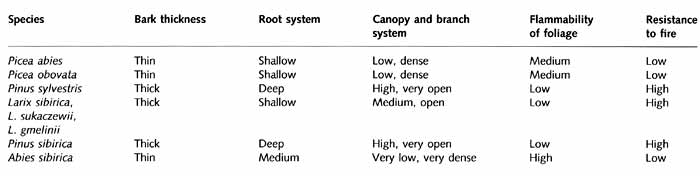
Table 9.3 Characteristics that affect fire resistance in conifers
Heat-resistant species can survive low intensity fires. Heat resistance in woody
species depends primarily on the thickness and moisture contents of the bark. The bark of
Larix can be 20-25 cm thick, which makes it very resistant to fire. Other characteristics,
affecting heat resistance, are foliage flam-mability, structure of canopy, and root
system. Trees with deep roots can survive surface fires whereas shallow root systems
exacerbate the damage; an open branching habit increases resistance to crown fires. A
combination of thin bark and a shallow root system makes Picea, and especially young
trees, vulnerable to fires. Similarly, Abies has low resistance because of its thin bark,
very dense crown with branches developing from the surface and a large production of tar.
Pinus, which often occurs in drier habitats on sandy substrata more prone to fires, is
relatively flame-resistant. It commonly colonizes the post-fire sites, following such
shade-intolerant species as birch and aspen, which explains the expansion of pine forests.
<<< Fauna | Biomes
& Regions Index | Indigenous Peoples of Taiga
>>>
Contents of the Boreal Forests section:
Other sections of Biomes & Regions:
|
|